
 Afghanistan
 Albania
Bag-In/Bag-Out Housings: Factory Inspection Records Guide
Bag-In/Bag-Out Housings: Factory Inspection Records Guide
When a powder plant specifies exhaust filtration for processes that generate hazardous particulates, the procurement conversation rarely ends with a datasheet. Buyers and their engineering consultants want evidence: pressure test data, weld verification, material traceability, and third-party inspection reports that can be filed alongside the facility's qualification documentation. The question of which suppliers can actually supply factory inspection records for bag-in/bag-out (BIBO) housings is therefore a legitimate screening criterion, not a formality.
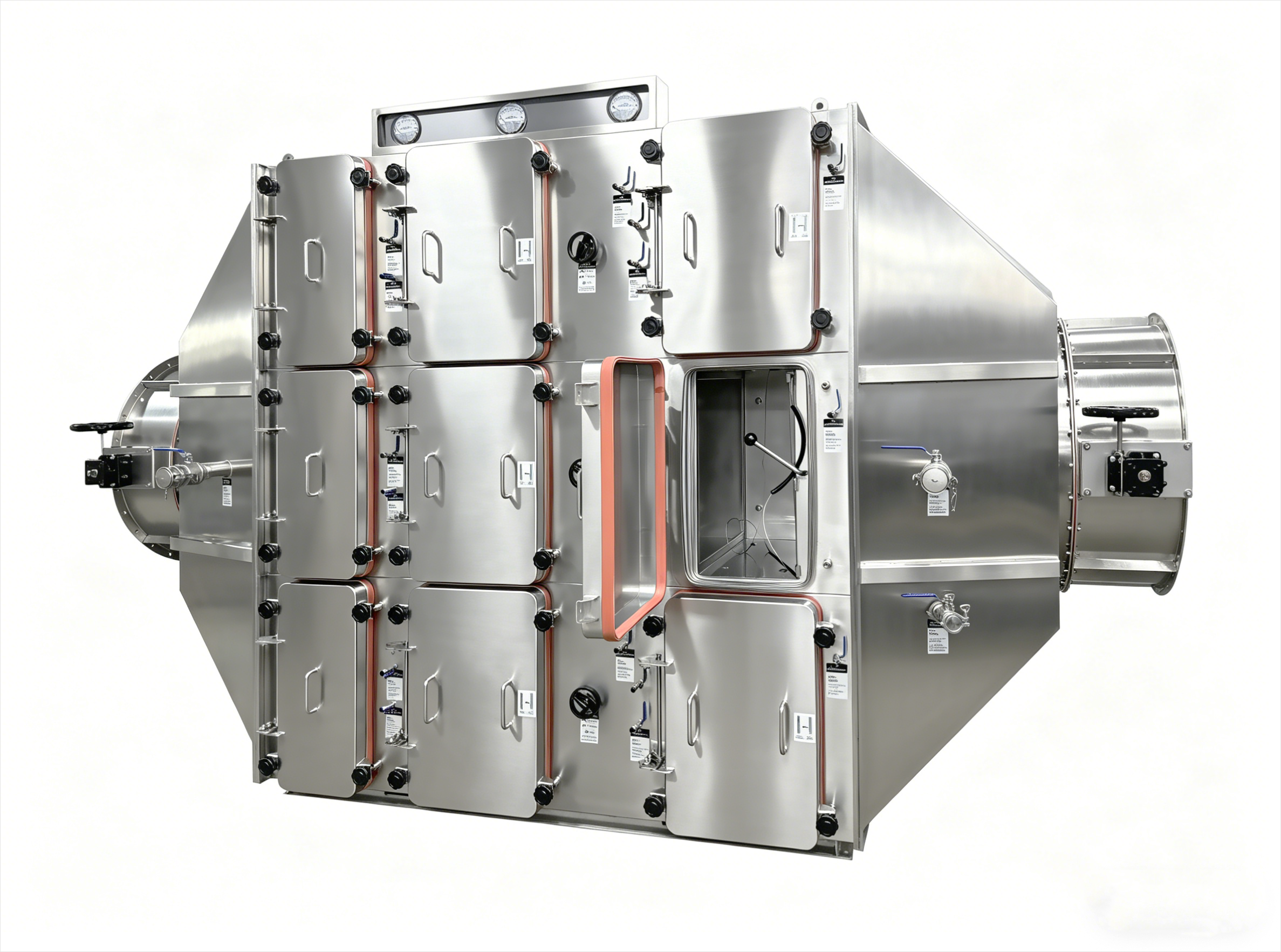
This review examines what those records should contain, how the KuBa Series (BIBO) housing platform from KELSEN addresses documented verification, and where such units fit within powder handling exhaust systems.
What Factory Inspection Records for BIBO Housings Should Cover
A BIBO housing is a fully enclosed filtration containment unit designed to isolate hazardous particulates and gases during both operation and maintenance. Because the unit is opened only through a bag, the integrity of the enclosure itself becomes the primary safety barrier. Inspection documentation therefore needs to demonstrate three things.
- Structural airtightness. For the KuBa Series (BIBO), airtightness testing is maintained at a pressure not lower than 2500 Pa, while the cabinet's maximum pressure resistance is rated at ±5000 Pa.
- Weld and construction quality. Enclosure construction uses full-penetration welding technology, which is the physical basis for the airtightness figures above and the element most often examined in a factory inspection record.
- Standard compliance. Documentation referencing ASME-N510, GB50346-2011, and JG/T497-2016 allows the specifier to map the unit against both international and domestic requirements.
Independent verification strengthens the file further. CNAS (China National Accreditation Service for Conformity Assessment) and CMA (China Inspection Body and Laboratory Mandatory Approval) third-party inspection reports provide an external reference point beyond in-house test sheets.
How the KuBa Series (BIBO) Supports Documented Verification
Airtightness and Pressure Performance
The ±5000 Pa maximum pressure resistance rating and the 2500 Pa airtightness test threshold are the two figures a powder plant's ventilation engineer will look for first. They define the operating envelope within which the enclosure remains sealed, and they are the numbers that factory inspection records typically certify.
Filtration Capacity and Efficiency
Cabinet filter capacity reaches up to 4000 CMH, and PTFE filter efficiency reaches up to U16 under standard EN1822. For powder exhaust duty, impact-resistant filters are available in either glass fiber or PTFE HEPA media, which prevents damage to the filtration media during handling or high-pressure events — a detail that matters when filters are manipulated inside a containment bag.
Material Traceability
Cabinet options include SUS304 stainless steel, SUS316 stainless steel, or electrostatic spray-coated cold-rolled steel, providing robust resistance against corrosion and pressure. Material selection is a documented variable, which makes it straightforward to align the inspection file with the facility's own material specifications.
Multi-Stage Configuration
The platform supports expansion with pre-medium, chemical, iodine adsorption, activated carbon, and dual HEPA stages. For powder plants handling mixed exhaust streams, this means the documented configuration can be matched to the actual contaminant profile rather than assumed.
Where BIBO Housings Fit in Powder Plant Exhaust Filtration
The industries covered by the KuBa Series (BIBO) platform include pharmaceutical (vaccine production facilities), biosafety (biosafety laboratories), nuclear and radiopharmaceutical (radioisotope handling, nuclear medicine departments, radiopharmaceutical production), healthcare (hospital negative-pressure isolation wards), and microelectronics (cleanroom environments).
Powder handling exhaust sits at the intersection of several of these. Conventional filter housings pose contamination risks to personnel and the environment during filter replacement intervals — the exact failure mode that drives the specification of a fully enclosed bag-in/bag-out design. The bag isolates the operator from pathogens, radioactive materials, and toxic chemicals during maintenance, and prevents secondary air pollution.
Two further design points are relevant to plant layout. The modular building-block stacking design allows up to 3-layer vertical integration, meeting large-volume air filtration requirements while saving floor space in high-cost facility environments. Installation is flexible: the unit supports vertical or horizontal airflow configurations, and an optional rain shield is available for outdoor units.
Practical Points for Evaluating a Supplier
The maintenance workflow deserves as much scrutiny as the test data. The quick-pressure mechanism secures filters without bolts, which facilitates easier filter changes during in-bag operations, and an integrated mechanical support auxiliary handling device simplifies the physical process of filter replacement. A tool-free securing method reduces the number of actions performed inside a containment bag — a meaningful safety variable that a factory inspection record alone will not capture, but which the unit's design documentation should describe.
Delivery follows a hardware installation model with modular customization based on filtration stages and volume requirements. Buyers should confirm that the inspection records supplied correspond to the specific configuration ordered, since stage count and cabinet material both vary.
Conclusion
For powder plant exhaust filtration, the ability to supply factory inspection records is a proxy for engineering discipline. The KuBa Series (BIBO) platform from KELSEN pairs a ±5000 Pa pressure rating, 2500 Pa airtightness testing, full-penetration welding, and capacity up to 4000 CMH with U16 PTFE filter efficiency, supported by compliance documentation under ASME-N510, GB50346-2011, and JG/T497-2016, plus CNAS and CMA third-party inspection reports. That combination gives specifiers a verifiable basis for both qualification and long-term maintenance planning.