
 Afghanistan
 Albania
Bag-In Bag-Out Exhaust Air Housing Manufacturer in China: A Buyer's Guide
In facilities where exhaust air may contain hazardous particles, toxic substances, radioactive materials, or biological contaminants, filtration equipment must do more than capture pollutants. It must also help protect maintenance personnel and prevent contaminants from escaping during filter replacement. This is why Bag-In/Bag-Out (BIBO) exhaust air housing is widely used in environments with strict air containment requirements.
For buyers planning a pharmaceutical facility, biosafety laboratory, nuclear-related project, or negative-pressure healthcare area, choosing the right BIBO exhaust air housing manufacturer is an important part of the ventilation system design. The equipment must match the required airflow, filtration efficiency, installation conditions, and maintenance procedures.
As a manufacturer specializing in air filtration and containment systems for critical environments, KELSEN provides BIBO solutions designed for different exhaust filtration requirements. This guide explains the key factors buyers should consider when selecting a BIBO exhaust air housing supplier in China.
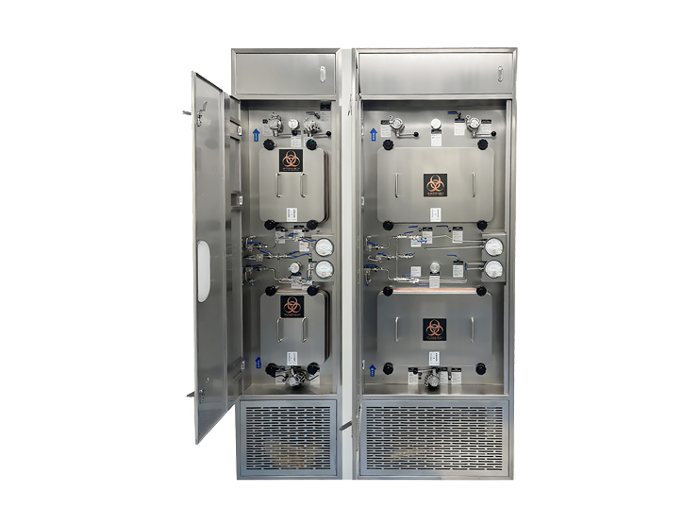
1. What Is a BIBO Exhaust Air Housing?
A Bag-In/Bag-Out exhaust air housing is a filtration enclosure designed to treat potentially contaminated exhaust air while allowing filters to be replaced through a protective bag system.
In a conventional filter housing, maintenance personnel may need to open the access door and directly handle used filters. If the filters have collected hazardous contaminants, this process can create a risk of exposure or contamination outside the equipment.
A BIBO system uses a protective change-out bag attached to the housing access opening. During filter replacement, the used filter is handled and removed within the protective bag. The replacement filter is then installed through the same controlled procedure.
This arrangement helps reduce the possibility of contaminants contacting operators or entering the surrounding environment during maintenance. The actual level of protection depends on the housing design, bag system, operating procedures, and site-specific safety requirements.
BIBO exhaust air housings are commonly considered for:
High-level biosafety laboratories
Pharmaceutical manufacturing facilities
Nuclear industry facilities
Negative-pressure wards and healthcare environments
Industrial areas requiring controlled exhaust filtration
For projects involving hazardous exhaust streams, buyers should evaluate the complete containment and maintenance process rather than focusing only on the filter efficiency.
2. Key Design Features to Check Before Purchasing
Not all BIBO housings are designed for the same operating conditions. Before selecting a manufacturer, buyers should review several structural and functional details.
Housing Material and Construction
The enclosure material affects corrosion resistance, structural strength, cleaning requirements, and service life.
For example, KELSEN's BIBO exhaust air housing uses a fully welded 2 mm SUS304 stainless steel enclosure. Cold-rolled steel is also listed as a material option in its technical specifications.
When evaluating a supplier, confirm:
Whether the selected material is suitable for the exhaust environment
Whether the enclosure uses a fully welded construction
How access doors and connection points are sealed
Whether the housing can meet the project's airtightness requirements
Whether material requirements can be adjusted for special applications
For corrosive exhaust conditions or specific cleaning procedures, the material should be selected according to the actual process and chemical exposure.
Protective Bag and Filter Replacement Structure
The change-out arrangement is one of the most important parts of a BIBO system.
Buyers should check the protective bag length, attachment method, sealing arrangement, and available handling features. The bag must provide sufficient working space for operators to remove and install filters without unnecessary exposure risks.
KELSEN's product design includes a protective bag of approximately two meters at each access door, together with straps and safety belts. Its premium model can also be equipped with two internal gloves to support filter handling.
The final configuration should be reviewed with the maintenance team to ensure that the replacement procedure is practical for the selected filter size and installation position.
Airtightness and Sealing
A BIBO housing is part of a containment system, so enclosure sealing and construction quality matter.
KELSEN states that its housing structure is designed to provide good airtightness and meet the testing requirements of ASME N510 and JG/T 497-2016. Buyers should ask the manufacturer to clarify the applicable test method, acceptance criteria, and documentation for the specific project.
It is also important to distinguish between the airtightness of the housing and the filtration efficiency of the filter. These are separate performance aspects and should be verified through appropriate tests.
3. Select the Right Filtration Configuration
The filtration arrangement should be determined by the contaminants in the exhaust air, the required treatment process, and the system's airflow conditions.
A single-stage configuration may use one HEPA filter. For more demanding applications, a multi-stage arrangement can combine pre-filters, medium-efficiency filters, HEPA filters, chemical filters, or activated carbon sections.
Typical configuration considerations include:
| Filtration arrangement | Main consideration |
|---|---|
| Single-stage HEPA | Suitable where one high-efficiency filtration stage meets the project requirements |
| Pre-filter + HEPA | Adds an upstream filtration stage to reduce the particle load reaching the final filter |
| Medium filter + HEPA | Provides staged filtration for applications with higher dust loads |
| HEPA + activated carbon | Combines particle filtration with treatment for specified gaseous contaminants |
| Dual HEPA | Provides two high-efficiency filtration stages where the process design requires them |
KELSEN lists H14 HEPA filters in its standard configurations, with optional ultra-high-efficiency or PTFE filters. Multi-stage filtration and activated carbon sections are also available.
For projects involving gases or chemical vapors, buyers should identify the specific substances and concentrations before choosing an adsorption medium. Activated carbon is not a universal solution for every gas, and its suitability depends on the chemical properties and operating conditions.
The supplier should also confirm the filter dimensions, replacement access, pressure drop, and compatibility with the exhaust fan.
4. Check Airflow Capacity and Technical Specifications
Correct airflow selection is essential for stable exhaust system operation. An undersized housing may restrict the required airflow, while an unsuitable configuration can increase pressure drop and affect fan performance.
KELSEN provides several standard BIBO exhaust air housing configurations:
Single-layer dual filtration: maximum airflow of 850 CMH
Primary and advanced filtration: maximum airflow of 1,700 CMH
Medium, advanced, and activated carbon filtration: maximum airflow of 3,400 CMH
The listed HEPA section uses H14 filters in accordance with EN 1822. Standard dimensions are available, and customized sizes can be considered according to site requirements.
These figures are reference specifications for the listed configurations, not a substitute for project-specific engineering. Buyers should provide the required airflow, available installation space, duct dimensions, filter arrangement, and expected operating conditions.
It is also useful to ask for the pressure-drop information of the selected filter combination. This helps the ventilation engineer assess whether the housing and fan can operate together as intended.
5. Consider Installation Space and Maintenance Access
BIBO exhaust air housings are often installed in areas where space and maintenance access are limited. The installation arrangement should therefore be considered early in the project.
KELSEN's product is designed for side-wall installation. Its recessed installation arrangement allows the air intake surface to sit flush with the wall, helping reduce the space occupied by the equipment and providing a cleaner appearance.
Horizontal installation is the standard arrangement, while vertical or other installation methods can be customized according to site conditions.
Before confirming the design, buyers should check:
Available wall and ceiling space
Air inlet and outlet duct positions
The direction in which filters will be removed
Clearance for protective bags and maintenance work
Access for inspection and filter testing
Whether the equipment will be installed indoors or outdoors
If the housing is installed outdoors, additional protection such as a rain shelter may be required. For systems connected in series, the design should also consider whether a longer gas residence time is needed.
Providing drawings and site dimensions during the quotation stage can help the manufacturer identify potential installation problems before production.
6. Evaluate Testing and Monitoring Functions
A reliable BIBO system should support inspection and maintenance throughout its operating life.
Depending on the project, useful functions and accessories may include:
Online filter leak testing: A PAO scan section or suitable testing arrangement can help verify filter integrity without removing the filter from the housing.
Differential pressure monitoring: A differential pressure gauge or sensor measures the pressure difference across the filter. Changes in pressure can help maintenance teams assess filter loading and determine when further inspection or replacement is needed.
Shut-off valve: A biosafety shut-off valve or other suitable isolation arrangement can help separate and block airflow during specified maintenance procedures.
Disinfection connection: A disinfection port can support treatment of the housing interior when required by the facility's operating procedure.
Instrumentation protection: Additional protection can be considered for personnel when instruments need to be inspected, replaced, or calibrated.
Not every project requires every accessory. Buyers should identify which functions are necessary for operation, testing, and maintenance, then confirm the final arrangement with the equipment manufacturer.
7. Why Work with an Experienced BIBO Housing Manufacturer in China?
Working directly with a manufacturer can make it easier to coordinate equipment design, filtration configuration, installation dimensions, and project documentation.
However, buyers should look beyond a supplier's product catalogue. A suitable manufacturer should be able to understand the application, review technical requirements, and provide practical recommendations.
When comparing BIBO housing manufacturers in China, consider the following:
Engineering experience: Has the supplier worked with pharmaceutical, laboratory, healthcare, or other controlled environments?
Manufacturing capability: Can it handle enclosure fabrication, welding, assembly, and inspection?
Customization: Can it adjust dimensions, filtration stages, materials, and installation arrangements?
Testing support: Can it provide relevant inspection and test records for the ordered equipment?
Technical communication: Can its engineering team review drawings and clarify project requirements?
After-sales support: Can the supplier assist with installation questions, maintenance guidance, and replacement components?
KELSEN has specialized in air filtration and containment systems for critical environments since 2006. Its product range includes BIBO systems, bubble-tight dampers, isolators, VHP decontamination pass boxes, airtight doors, and other containment equipment.
The company provides design, research and development, production, and technical support. Its company information also identifies ISO 9001 and ISO 13485 certifications, along with quality inspections, airtightness verification, leak testing, and Factory Acceptance Testing (FAT), as applicable to the equipment and project.
For more information about the company and its engineering capabilities, visit the KELSEN company profile.
8. What Information Should Buyers Prepare for a Quotation?
A detailed inquiry helps the manufacturer recommend a more suitable configuration and reduces unnecessary revisions during technical discussions.
Before contacting a BIBO exhaust air housing supplier, prepare the following information where available:
Application: Pharmaceutical production, biosafety laboratory, nuclear facility, negative-pressure ward, or another environment.
Airflow requirement: Normal and maximum operating airflow.
Filtration requirements: Filter grade, number of stages, and whether chemical or activated carbon filtration is needed.
Installation details: Horizontal or vertical installation, wall opening dimensions, and duct connection sizes.
Material requirements: Stainless steel or other specified enclosure materials.
Testing requirements: Filter leak testing, airtightness verification, and project-specific inspection documents.
Optional functions: Shut-off valve, differential pressure monitoring, disinfection port, or other accessories.
If the project has special containment or regulatory requirements, include the relevant technical specifications in the inquiry. The manufacturer can then review the requirements and identify which details need further confirmation.
Conclusion
Selecting a BIBO exhaust air housing is not simply a matter of choosing a filter enclosure. Buyers need to consider containment during filter replacement, housing construction, filtration stages, airflow capacity, installation conditions, and long-term maintenance.
An experienced manufacturer should be able to translate these requirements into a practical equipment configuration and provide the technical coordination needed for the project.
KELSEN specializes in air filtration and containment systems for critical environments and offers BIBO exhaust air housing solutions with configurable filtration stages, monitoring accessories, and installation arrangements.
To review the product structure and available configurations, visit the Bag-In /Bag-Out Exhaust Air Housing product page. For broader information about its filtration and containment solutions, visit the KELSEN official website.